

The land was the color of burnt caramel. It was flat and it was featureless: there was no tree in sight, no blade of grass, no ditch, no dune, no sand, no shrub, no ups, no downs. There was nothing, not even a boulder, to disturb the absolute flatness of the ground. The ground was hard, covered in gravel the color of burnished iron ore. Light wisps of white cirrus lifted from this one-dimensional landscape and burnt up in the blazing sun. A wind whipped up a fine dust that blew around our ankles. The mid-morning summer heat shimmered, painting mirages on the horizon.
To the untrained eye this was wasteland: barren, arid, infertile, hard, uncultivable.
],[https://www.peepli.org/wp-content/uploads/2015/05/aagor-1000x438.jpg,(medium)],[https://www.peepli.org/wp-content/uploads/2015/05/aagor-1600x700.jpg,(large)])
But I had heard of miraculous happenings in this area. Of old magic, where new farmers practiced ancient mantras to reap lush fields of gold sans irrigation. How could that be? It defied logic.
And now, standing here on this pencil drawn hard line of impermeable treeless land, it seemed even more incredible.
For Chhattar Singh, a farmer-shepherd from Ramgarh, a town about 60 km north of Jaisalmer in Western Rajasthan, this was a place for hushed voices. He had traversed the district, scrub to dune, learning to read the soil, identify the vegetation, gauge the water content, recognize spots for wells and ponds and lakes, calculate the gradient of land, the flows down each, and more: the relationship of each of these elements to the others.
This was, he told me in a reverential whisper, a catchment area, a watershed, an aagor in local parlance. It was where the rains would fall first – and when it fell, none of it would soak into the impermeable soil; instead, it would flow down an imperceptible slope to a khadeen, a depression.
We had by now whiplashed in a 4×4 to an overlook with a drop-off shaped like the nape of a neck that curved down into another expanse of flatness which, further on, dropped into yet another. At the very edge of the overlook rose a conical carved pillar about seven feet high and three feet wide at the base, with a seated figure carved into it near the top. The identity of the figure was not clear – was it a Jain muni, or Mahavira, or was it the Buddha? An inscription on the pillar simply said 530, which was probably the year in the local lunar calendar – that is, to some point in the fifth century A.D.
“Shila-ji”, Chhattar Singh calls the pillar, in that same soft, reverent tone. He said such pillars were to be found in any place of supreme beauty. In course of my travels, I noticed such pillars standing sentinel on almost all the aagors, the high points of catchments. Did the ancients who were so intimate with the land put it there to acknowledge the sacred silence of a catchment?
The Bhil
We drove across the aagor, over ground burnt dark and baked hard by the relentless sun. Gradually, a row of trees came into view across the horizon. It marked the beginning of the end of this catchment. Where there are trees, there probably is water – but this was May, and the height of summer. There was no water in sight on this large tract of land, dotted and fringed by the feathery giving tree of the desert, the khejri. We’d reached a khadeen.
A group of men headed towards us. “Look at his face – there is no water in it,” said Chhattar Singh, pointing in the direction of a wan young man, slight of build, with unwashed hands poking out from a grimy blue shirt and a shock of sand-caked hair that stood all on end. “He is like the God of Death.”
The young man was the first to reach us. His eyes shifted from Chhattar Singh to me and back again, and then they fell. “Mohan Ram is a Bhil, and he has chosen the curse,” Chhattar Singh joked by way of introduction.
The other members of the group had reached us by then. A tall wiry man with smooth high cheekbones and eyes with a slight oriental cast, dressed in a spotless white kurta-pyjama, greeted Chhattar Singh warmly. This was Gaji Ram, another Bhil, and he was accompanied by his three sons, all in their early twenties and dressed in smart pants and t-shirts, with smiles on their faces and ceremonial red threads, the relics of some recent festival, on their wrists. They all laughed and nodded agreement at Chhattar Singh’s comment who, for my benefit, related the story of why goddess Parvati cursed the Bhils.
One evening, the Goddess, with her consort Shiva, looked down on the Bhils from her abode high up in the mountains, and was moved by their plight. Driven by a desire to help her brothers, Parvati persuaded Shiva to put a silver pot in their way as they walked home for the night. The Bhils strolled past the pot without so much as noticing it. Shiva smirked knowingly, but Parvati did not give up. She presented them with a majestic bull – none other than the sacred Nandi who, she told her brothers, would help lift them out of poverty.
The Bhils thought the bull would magically make their life better. When nothing happened, they wondered if Parvati meant there was a treasure hidden inside the bull – and so they killed it. When she heard of the slaying of the sacred bull, Parvati was enraged. “Because you killed a sacred and beautiful creature, you will never amount to much in farming!”, she cursed.
The story goes that generations of Bhils have since grown up believing in the curse and developing a fatalistic attitude to their lot. ‘We are cursed, so there is no point in working,’ was the pervasive mindset. Mohan Ram is one such, Chhattar Singh said; “he has chosen the curse.”
His tone was dismissive, contemptuous almost, of the Bhil’s acceptance of his impoverished lot. The squatting Mohan’s grimy fingers tugged a blade of grass loose from the baked earth; he twirled it abstractedly, his waterless face set grim.
The Paliwals
A Khadeen is Old Magic. S. Vishwanath, a guru of rainwater harvesting and an expert on ancient methods of water management says,
“It translates to much more than a farm. It is at the same time a water harvesting structure, a soil moisture retaining structure and a field.”
Dating back 700-900 years Khadeens are the brainchild of a people who no longer live here, the Paliwal brahmins. A fabled, a mysterious people, their stories are part of an oral culture that has left no written documentation of their history. All accounts are based on conjecture, stories handed down over generations, and derived from archeological studies of the villages they abandoned en masse in the 19th century, seemingly in a hurry.
Where could I find the Paliwals' bard?
Since their culture was oral, they employed bards and minstrels in their service to sing of their history, their genealogy. These minstrels belonged to the Manganiyar community, the generational bards of the Thar desert and only a few of them today still sing the Paliwal history.
Let’s wind the time-turner back to 1273 AD.
In Kuldhara in Jaisalmer county, a Brahmin named Kadhan, squats on the dhora (a 3-4 m high bund) of his dry khadeen (farm), and looks eastwards in the direction of Pali, the town his people had recently fled from. Memories of the massacre of thousands of his people, and the terrified overnight flight of the survivors, overwhelm him as he leans back against an old jaal tree.
Lured by the fabled prosperity of Pali in Rajasthan, Nasir-ud-din Mahmud Shah I of the Delhi Sultanate had descended on the city with his army and laid siege to it. The resident Brahmans and their Rajput protectors, numbering in thousands, held out, trusting in their knowledge of agriculture and water management.
Kadhan recalls that August night, at the tail end of a day punctuated by spies bringing bad news. The Shah, they said, had been growing impatient with the long siege. “How do these Brahmins manage to stay inside their city?” he raged. “Don’t they need water and food?”
The secret was that they didn’t.
They were self-sufficient with a large lake, called Bijhano, which supplied fresh, sweet water to the inhabitants. And the Brahmans were expert agriculturists; their granaries were always full. With plentiful food and a reliable water source, the Brahmans were in a position to withstand even the most prolonged siege.
This strength, the devious Shah had realized, was also a weakness. He ordered quantities of rich geru (red oxide) powder to be dumped in the lake. When the residents of Pali, who were strict vegetarians, had found the color of blood in their water, their grief and rage knew no bounds.
In their anger, they threw the city gates open and, in the hundreds of thousands, they – Brahmans and sadhus and Rajputs all — rushed out against the Shah’s troops, embracing certain death under the full moon of Raksha Bandhan.
Kadhan has no clue how many perished. He has heard that the collected janeu (the sacred Brahman thread) of the dead Brahmans collectively weighed 8 maunds(320 kg). He shudders at the implication of that figure.
The survivors of that massacre had fled west and dispersed among 84 villages, called a khera, in and around Jaisalmer. Here they made their homes and started rebuilding their lives from scratch. They were now called the Pali-walas — the Brahmans from Pali.
Kadhan is the leader of one such. He settled with his family in the village Kuldhara and, drawing on the knowledge of his tribe, had set to work to make a lake that would sustain them. He named the lake Udhansar, and built several khadeens in appropriate places. Khadeens were the Paliwal’s secret to not just surviving, but thriving in the unforgiving desert. Kadhan knows how to read the soil, the gradients of the land, the wind, the weather; he knows with the knowledge of generations where and how to find hidden water. His khadeens would give kharif and rabi crops, sugarcane, wheat, gawar, or bajra, enough to feed the wholekhera and then some, yet not harm the land. Any excess crop would bring in money from trade.
Kadhan stands up, straightens his jama (tunic) and readjusts his khanjar (dagger) into his kamarband (waistband). Reaching into an inside pocket, he brings out a small pouch of freshly procured Malwa opium of the best quality. Pinching off a bit and he shapes it between finger and thumb into a small ball, and sticks it under his tongue and begins walking the length of his newly prepared dhora. He appraises the gentle upward slope of the flat, empty, hard aagor and decides he has read the land right. He has done all that is needed.
Now he has to wait for the rains.
],[https://www.peepli.org/wp-content/uploads/2015/05/silt-1000x667.jpg,(large)])
Waiting For The Rains
It was July 2014 and Chhattar Singh was waiting for the rains.
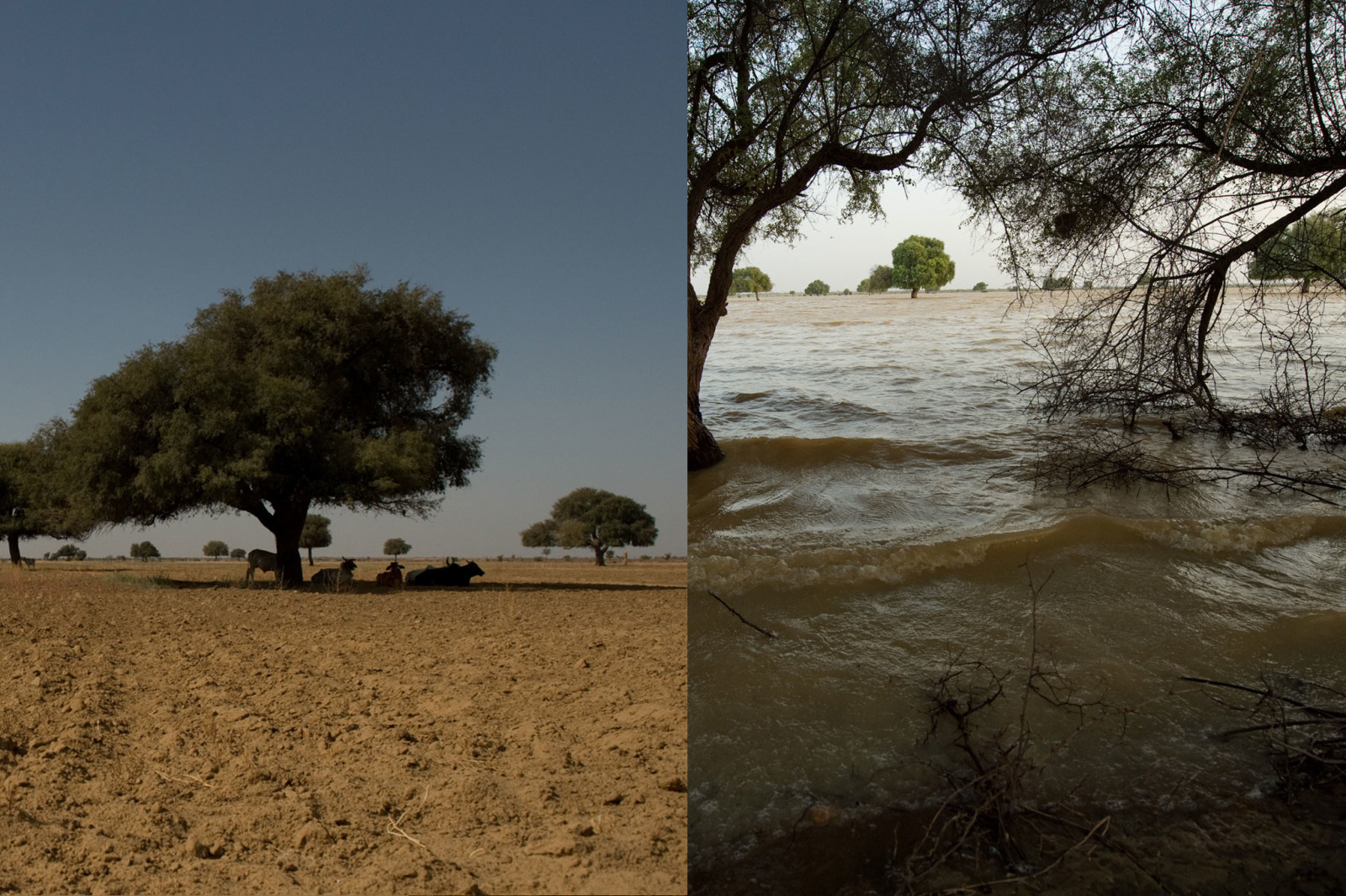
We climbed down from the dhora and looked out at the khadeen – one that a Paliwal Brahman like Kadhan had built, some 700 years ago – that stretched out in front of us. Our gaze swept across a large depression, spreading over many acres and cupped by a curve of a 10-foot-high dhora. The ground was drier than bone, all cracked and broken and scarred.
It only needed to rain once, sometime during the southwest monsoon – about 80 mm is what the region gets on an average. That is not much – the state of Kerala, which is somewhat smaller in area than Jaisalmer district, gets a whopping 3000 mm of rain on average during the season – but 80mm is all Chhattar Singh, with his knowledge of the land, needs to thrive. 80 mm of rain, running down the aagor and coming to rest in the depression flanked by the dhoras, would suffice.
The Government's Plans For The Thar
The soil in the khadeen – significantly different in composition from that of the aagor – relents; it allows water to seep beneath the surface. The earth drinks deep, saturating itself slowly over the space of two months. And then it is ready to accept the seed. Farmers sow wheat, two kinds of mustard, gram, and guar bean to reap in the winter. They would not need a single drop of water other than this one rain.
The soil stays moist and thick. Moreover, the rolling rainwater would bring with it detritus: sheep, goat, and cow poop from the aagor which would make for rich fertilizer. Successive seasons of such farming leaves the land only richer and more fertile. Farming the khadeen way is a matter of being gentle with the land, understanding the nature of it, and optimizing it to derive maximum benefit from the minimal rainfall.
It was by harnessing this knowledge that, in the centuries after their flight from Pali, Kadhan and the other surviving Paliwals grew rich beyond imagination.
Listen To The Paliwal Chhand
“They knew a mantra,” said a convinced Manganiyar Dersi Khan, one of the few Manganiyars who still recites the history of the Paliwals. “They could summon rain when they wanted. Lord Indra was at their service. And that’s why they never knew famine.”
Realistically, did the Paliwals’ success come down to their relationship with the land? Was their secret this, that they understood the soil well and, based on that knowledge, they placed their khadeens in the right places and lived in harmony with the seasons? Was this their magic mantra? Everything pointed to it.
The Paliwals seem to have been a practical and highly intelligent people, – one with the land and working with nature, not against it. Their bulls were mighty – tall and strong, not like any we have today, and their agronomics were sound. Not only did they successfully cultivate an inhospitable land and unfriendly climate, they also traded crop for ghee (clarified butter), which they exported to foreign countries, raking in riches. They were a mix of agriculturists and pastoralists; the latter sustaining them during the dry seasons.
They traded in bulls and horses, with Jaisalmer as the trading outpost along a side-arm of the silk route. So successful were they that it is said almost all trade in the country passed at some point through Paliwal hands. Legend has it that while the Paliwals who left Pali by the west gate became cultivators; those that left by the east gate became merchants.
Wherever they went, they were prosperous and secure – their security stemming from the fact that they never lacked for water or grain, for they knew how to master the harshest clime in India: the Thar, where they had thrived for over six centuries.
But Kadhan’s Kuldhara, along with most other Paliwal villages, lies in ruins today. Some say the Paliwals left when a roving-eyed licentious Diwan harassed the Paliwal chief’s daughter. With such a roaring business, such riches, so much trade hinging on them, with bazaars and haats eating out of their hands, and such clout with royalty, what kind of oppression drove them to move again?
Local lore also has it that the Diwan in his obsession began hurting their water resources: desecrating lakes, dumping in wells. Finding water and using it almost reverently meant everything to Paliwal prosperity. Was the destruction of water by the Diwan the last straw that broke the camel’s back?
We do not know. For there is no one left to tell that tale.
Gaji Ram
July was drawing to a close. The rain was over two weeks late and Gaji Ram, the Bhil, was beginning to despair. He had done everything exactly as Chhattar Singh had prescribed. He prepped his dhora by piling thorny bushes against it, allowing the howling desert winds of summer to deposit sand high as a natural barrier. The dhora was ready for the rains, the khadeen was waiting, but the rains wouldn’t come.
Further south, thick rain fell in thin veils; big marble-sized drops pockmarked the sand. In the desert, it rains in bands. Typically, each band of rain is about five km wide, with 5-7 km between them.
],[https://www.peepli.org/wp-content/uploads/2015/05/camels_rain-1000x666.jpg,(medium)],[https://www.peepli.org/wp-content/uploads/2015/05/camels_rain-1600x1065.jpg,(large)])
Over tea one evening, as the wind howled outside, Chhattar Singh told me of how the year before, a village on one side of the road had rains but a dhaani (small village outpost) on the other side had been passed by. One village saw a bumper crop, the other remained arid. Rain in the desert is like that, he said. Now I too was beginning to worry. I had seen rain further east, and gotten drenched in a downpour to the west. I worried that Gaji Ram’s dhaani was going to fall through the gap into drought – and that would be a tragedy in more ways than one.
Gaji Ram was not always a farmer. He was a Bhil, one of the accursed. He had been jailed once on false charges of maiming a cow. He had calloused hands from a stint as road laborer, and had known what it was to hold a begging bowl in his hand. Self-esteem at an all-time low, he had believed only in the curse.
The agent of change was his uncle Khamana Ram. He did not believe in curses or in fate. He believed in hard work, and he believed in Chhattar Singh, and the combination had made him rich.
On his deathbed, Khamana Ram had given his nephew Gaji Ram one piece of advice: “Whatever you do, listen to what Chhattar Singh says.”
But Gaji was a disbeliever. He resisted Chhattar’s counsel for a long while. Chhattar, wisely, did not push. He spent his own money on diesel for Gaji’s tractor but Gaji, with a Bhil’s flagging sense of destiny, chose to leave the engine running all night to burn up the fuel and make Chhattar think he had been working on the farm, rather than actually work on it.
What was telling here was that while Chhattar Singh knew the Old Magic, he did not for a minute believe it was his work to do. Over time and over endless sessions of bantal (friendly chit-chat) with Gaji, Chhattar Singh taught Gaji to believe. Believe in himself, and believe change was possible. “Doing their work for them was not the way to sustenance,” he repeated. “It has to come from within them. They need to want it enough and be prepared to put in the hard work, for a khadeen –or anything — to be a success. We need to change the hand-outs-and-aid mindset.”
Seated on the edge of the khadeen now, they recalled those times and laughed. “I never realized that Chhattar was spending for us, on us. I never imagined what could be possible,” Gaji said.
In time, Gaji had come around. By 2010, he and his three sons had built a dhora, the first step towards a khadeen. In the first year they each reaped handsome harvests of gram, wheat, and mustard, earning in excess of rupees four lakh each – a princely sum for a family used to living hand-to-mouth.
Gaji was now motivated and beginning to believe in himself; he had tasted the fruits of labor and found them sweet. And so he and his whole family had worked hard through the summer, preparing his dhora.
But the rain refused to come.
We were now well into August. The rest of India was either celebrating bountiful monsoons or ruing terrible floods. Gaji Ram’s strip of desert remained as dry as camel poop on a sand dune.


Then, early in the morning of August 15, the clouds came rolling in over the aagors and bombarded the land with rain. Over 100 mm of rain – more than the desert had seen in previous years – fell in just a few hours.
“It won’t stop,” a panicked Gaji Ram called Chhattar Singh to report. “ The water just keeps on coming. My dhora will burst. I’ll be ruined. What do I do?”
But his dhora held up. And his khadeen flooded. As did all the other khadeens in the district that had readied themselves for this day. Ten days after the cloudburst, the rainwater kept coming, flowing from the catchment area into Gaji Ram’s khadeen. The desert turned to marsh; and birds of all ilk flocked to it. Low-lying roads were submerged; elsewhere, high roads impeded water flows — aagor disrupted by thoughtless infrastructure and some khadeens denied their due.

Chhattar Singh and I climbed to the top of an old Paliwal dhora I’d seen many months prior. From this vantage point I could see the gentle upward slope of the aagor, in the distance – for now, there was water as far as the eye could see, and even khejri trees lay half submerged.
Such large khadeens are community owned. Every family regardless of caste has a stake in the farming, and a share of the harvest. The water that stretched out in front of us presaged a great year for the thirty villages that share this khadeen. Other khadeens all over the district were similarly full, heralding an upcoming season of plenty.
Now they would all wait two months for the water to soak slowly into the ground, prepping it for the farmers who, in November, will sow wheat, bajra, chana, mustard, black mustard and guar bean.
As I drove through the area, I found all village lakes in the district brimming with water — an amazing sight in a desert I had seen parched, cracked and broken just a few weeks ago. The lakes will give for eight months. No one dare swim in them, or bathe, or wash their clothes there, for these lakes are sacred – this is the lifeline of the desert; it feeds them, and gives them the only water they deem fit to drink.
Gaji Ram and his three sons accompanied Chhattar Singh on a walk around their khadeen, animatedly discussing the deluge of August 15. The water came to here, they said, pointing to where the wash-back showed clearly.
The detritus of that deluge still lay there, in dry brown waves. Vaazh, they called it, and it marked the high level of water. They would use this to calibrate theirdhoras and chaadars (canals) for the next season.
Gaji Ram laughed a lot. His weather-beaten face shone with excitement, with the sense of possibility.
There was much water in his face.
Epilogue
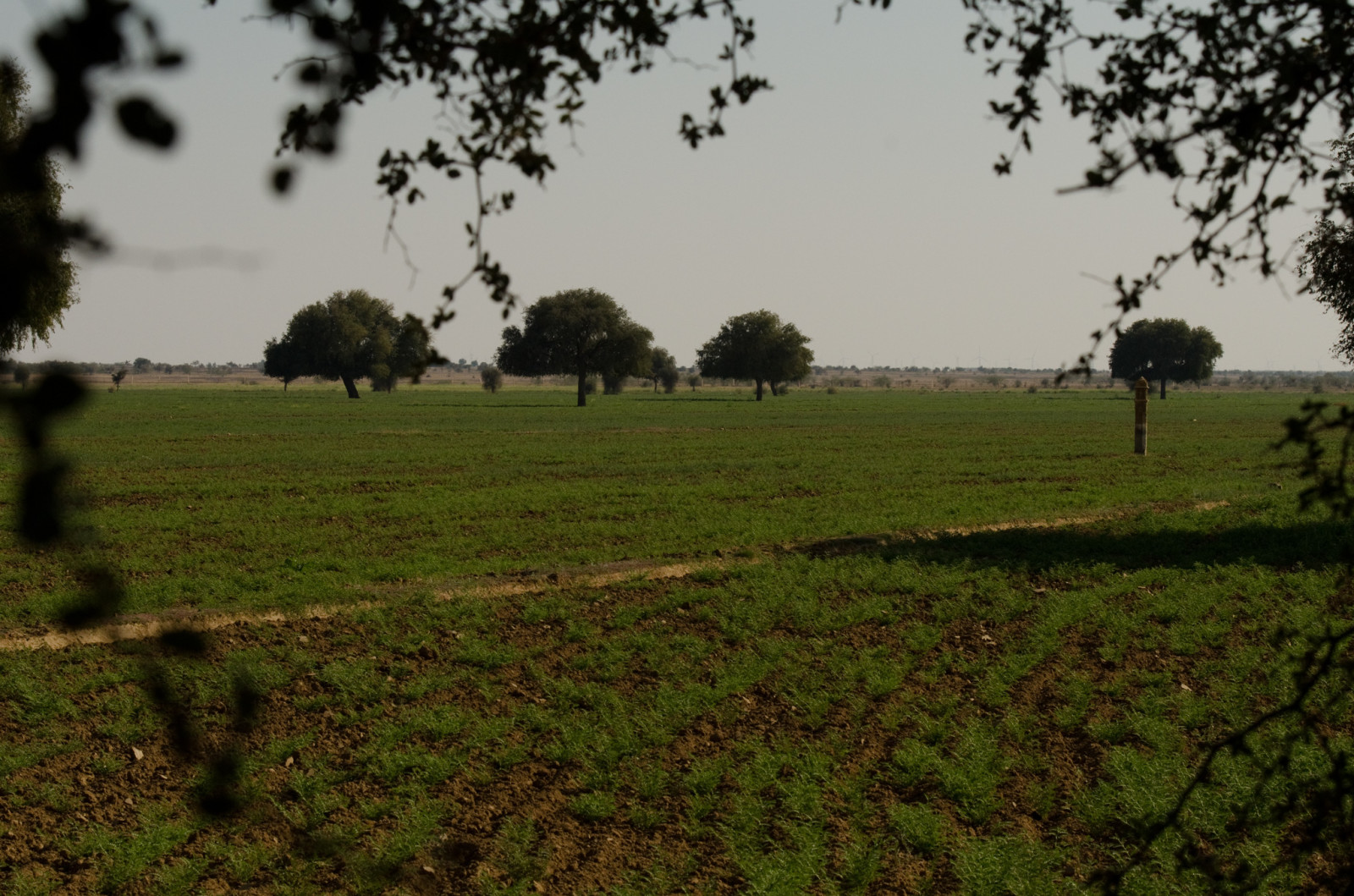
I went back to the district in winter when the crops were lush. Gaji and his family had planted diverse crops, extensively: a mosaic of vegetables, herbs, grains, and cereal. His wheat would sustain the family for a year. They would not sell it. His excitement was palpable and he could not be stopped.
Mohan had come around too, and made his dhora in the weeks before the rain. He had planted chana too.
Gaji’s cousins, and his sister – all taking cues from Gaji, had made their own dhoras and khadeens. The whole area was now a green and gold appliqué in a vast fawn-colored blanket.
A blanket that was plainly visible to Harchand who lived on a hillock. His family would not eat if his wife came back empty handed from begging in the villages. The sight below drove deep nails into Harchand’s gut. Now, he wanted green-gold too.
When I left, Chhattar Singh was engaged in deep bantal with Harchand.
],[https://www.peepli.org/wp-content/uploads/2015/05/gaji_birds-1000x563.jpg,(medium)],[https://www.peepli.org/wp-content/uploads/2015/05/gaji_birds-1600x900.jpg,(large)])
Also Read:
Wasting The Desert: In official terminology, much of the desert grasslands is “wasteland”. Look closer — hundreds of wonderful fauna, and thousands of shepherds, call this home
In Search of a Minstrel: The history of the Paliwals, a fabled people from long ago, is recorded in the ‘chhand’ — a poem handed down through generations of minstrels. I traverse the desert in search of one of the few surviving singers of history’s song


