

“[Bangalore] is unsuitable for development as an industrial center on a large scale.”
A 1923 conference to discuss the future of Bengaluru’s water supply was the canary in the coal mine. Its ominous warning fell on deaf ears. Following on from Part 1: Watering a City, I look at how a city ignored a foreseeable disaster:
_______________________
Hesarghatta, the mainstay of Bengaluru’s water supply, is all but sucked dry by consecutive years of failed monsoons. At one point in 1926, there is just four months’ worth of water left. City planners scurry back to the drawing board to find a fix.
The visionary Diwan of Mysore (1912-1918) Sir M Visvesvaraya urges the ruling family to find a solution. The resulting committee, which he chairs, considers and rejects rivers such as the Hemavati and the Cauvery. Both are at least 100 km away from the city; tapping their waters could prove prohibitively expensive.
On the premise that Bengaluru’s population will touch the 4.5 lakh mark by 1951, the committee identifies Thippagondannahalli as the site for another tank along the Arkavathy. The new reservoir can hold sufficient water for three and a half years, even if monsoons fail and there are no fresh inflows.
The plan is far-sighted, but does not budget for a peculiarity in the city’s psyche. Each time a new tank is built, the older, more localised water sources fall into neglect and the pressure on the new water source mounts exponentially. Thus, when the Thippagondannahalli tank starts to function, Hesarghatta fades and the smaller wells and tanks that service parts of the city fall into disrepair.
The tipping point comes in 1951, when heavy industrial units such as Hindustan Aeronautics Limited (HAL), Bharat Electronics Limited (BEL), Indian Telephone Industries (ITI) and Hindustan Machine Tools (HMT) flock to Bengaluru. The population hits the eight lakh mark, outpacing the planning.
The city planners are driven back to the drawing board. The strategy of building incremental reservoirs has played itself out. Nothing short of a perennial river can cater to the bottomless thirst of a rapidly growing city perched high on the Deccan plateau. In 1958, the planners turn to the sacred Cauvery – a river that flows a thousand feet below, and 100 kms distant from, the city.
],[https://www.peepli.org/wp-content/uploads/2015/05/arkavathy_fields_16x5-1000x312.jpg,(medium)],[https://www.peepli.org/wp-content/uploads/2015/05/arkavathy_fields_16x5-1600x499.jpg,(large)])
Late 17th century; Cauvery basin
Chikka Deva Raja Wodeyar, ruler of Mysore, had his eye on the fort of Trichinopoly in the Cauvery delta.
There was history here. The kingdom of Madurai, the largest in the area, had opportunistically wrested the fort from Wodeyar’s dalvoy when hostile Maratha armies showed up in the area (circa 1696). Determined to win it back from the Madurai Naik, Wodeyar hit on a ruthless strategy.
The Cauvery rises in the forests of Coorg in Karnataka (erstwhile Mysore), collects tributaries during its progress through the state, rushes through a narrow gorge and tumbles in spectacular falls into parts of Tamil Nadu including the kingdoms of Madurai and Thanjavur, where she enriches the delta before emptying herself into the Bay of Bengal. In this fashion she gives life to rich, fertile plains of millet and paddy and sugarcane, supporting millions of lives and livelihoods.
Wodeyar realised that the river, swollen by timely monsoons, held the key to the prosperity of his rivals in Madurai and Thanjavur.
“The Indians expect these rains as impatiently as the Egyptians did the inundation of the Nile,” Father Martin wrote in 1701 to Father de Villette, a Jesuit priest then traveling across India.
Ruthlessly exploiting the geographical advantage, Wodeyar caused a dam to be built, to block the river from flowing across the border. Deprived of the once dependable water source, the kingdoms of Madurai and Thanjavur feared a great famine and joined forces to combat Wodeyar’s injustice. The “Cauvery dispute”, thus, got under way over three centuries ahead of today’s headlines.
That year, the monsoon came early, and was unusually heavy. The Cauvery, fecund with rain as it hurtled down from the highlands, hurled herself headlong at the dam, sweeping it aside with disdain as she tumbled across the border. The river had imposed its will on warring states, and taken a hand in resolving the first ever Cauvery dispute.
],[https://www.peepli.org/wp-content/uploads/2015/10/kaveri_cropped-1000x562.jpg,(medium)],[https://www.peepli.org/wp-content/uploads/2015/10/kaveri_cropped-1600x900.jpg,(large)])
It is to the waters of the Cauvery that Bengaluru turns in the 1960s to slake its growing thirst. In 1964, the Bangalore Water Supply and Sewerage Board (BWSSB) is established. It is India’s first water-supply management board, and on it falls the onus of carting the Cauvery over a distance of 100 km to a city elevated over 1500 feet above the river.
“Bengaluru waters have the highest embodied energy at about 1.88 units of electricity per kilo-litre of water, possibly in all of Asia,” says S Vishwanath of Biome Environmental Solutions, an outfit with expertise in water management. “And it is among the costliest.”
The scheme becomes operational in 1971. Massive pipes, each 1,200 mm in diameter, push 135 million litres of Cauvery water per day (MLD) up the steep elevation and into the city at a cost of Rs 80 crore.
Bengaluru, which back in 1923 had been identified as being unfit for industrial development, continues to defy the warning and grows at pace. Within the decade, the population swells to 30 lakh, and another set of large cement straws are laid to suck up more water from the Cauvery. By 1981, a further investment of Rs 135 crore brings in another 135 MLD.
The project is fast becoming prohibitively expensive and unsustainable – but the city grows anyway as people and industries, seduced by the cool climate and the easy availability of skilled and unskilled labor, flock to it.
The population escalates at an inordinate rate – 40 lakh in 1991, 60 lakh by 2001, 70 lakh in 2007, one crore-plus by 2014. The water supply struggles to keep up. A further 270 MLD is pumped in 1993, another 270 MLD in 2002, a further 100 MLD in 2008, then 500 more MLD in 2013…
All of this comes at a prohibitive cost. Rs 360 crore in 1993, Rs 1072 crore between 1997-2002, Rs 3400 crore in 2013…
Today, 1400 MLD and Rs 4,987 crore later, the city is still in water deficit.
“With its population touching 1 crore, the city now requires 1,700 to 1,800 million litres of water per day (MLD). In summer, the demand shoots up to 2,100-2,200 MLD. But only about 1,450 MLD of water from Cauvery river, the only piped water source, is at the BWSSB’s disposal,” the Times of India reports in September 2014. “At least 35-40% of the Cauvery water is lost to theft and leakage, which can be blamed on the decades-old supply system.”
By now, the government is pushing for additional allocations for Bengaluru, which in turn means less water for irrigation.* As agriculture gets hit, the situation becomes ripe for violent protests in the countryside, particularly when the monsoon fails.
],[https://www.peepli.org/wp-content/uploads/2015/10/population_graphic-1000x821.jpg,(large)])
Here’s the rub: those giant straws laid down at enormous expense do not water the city uniformly. Many areas of Bengaluru are outside the direct footprint of the water supply system. With tanks and lakes and open wells falling into disrepair through neglect, the people are forced to look for other ways to quench their thirst. They turn their attention to the ground beneath their feet.
Borewells begin to be dug. In the 1980s, water is found at depths of 100 feet. But as the city grows, the pace of construction escalates and borewells burgeon, the water table is driven deeper with every passing year till, today, the wells sink 1000 feet and more beneath the city’s skin.
At this point, the groundwater is almost below the river itself — and that comes with its own set of consequences. As long as the water table is high, its base feeds the rivers and lakes. When the water table gets lowered, the reverse happens — the rivers and lakes now feed the groundwater.
Thus, the Cauvery is now being sucked dry at both ends — by the giant pipes that pump water into the city and by the bore wells that drive deeper each year, lowering the water table and forcing the river to feed it.
“Over 3.3 lakh borewells draw about 350 MLD of water, with apartment complexes being the biggest beneficiaries. Over 90% of the city’s 30,000 apartments depend on groundwater,” reports the Times of India.
Every foot a borewell sinks comes with a cost; the deeper it goes, the more expensive the water. And that is only one part of the problem. Water quality at such depths is suspect — some studies say over 90% of the borewells in Bengaluru cough up water contaminated with nitrates, iron, fluoride. And worse – the city is drawing on water it just doesn’t have. A 2011 report by the Central Ground Water Development Board says Bengaluru has exploited 141% of its groundwater resources.
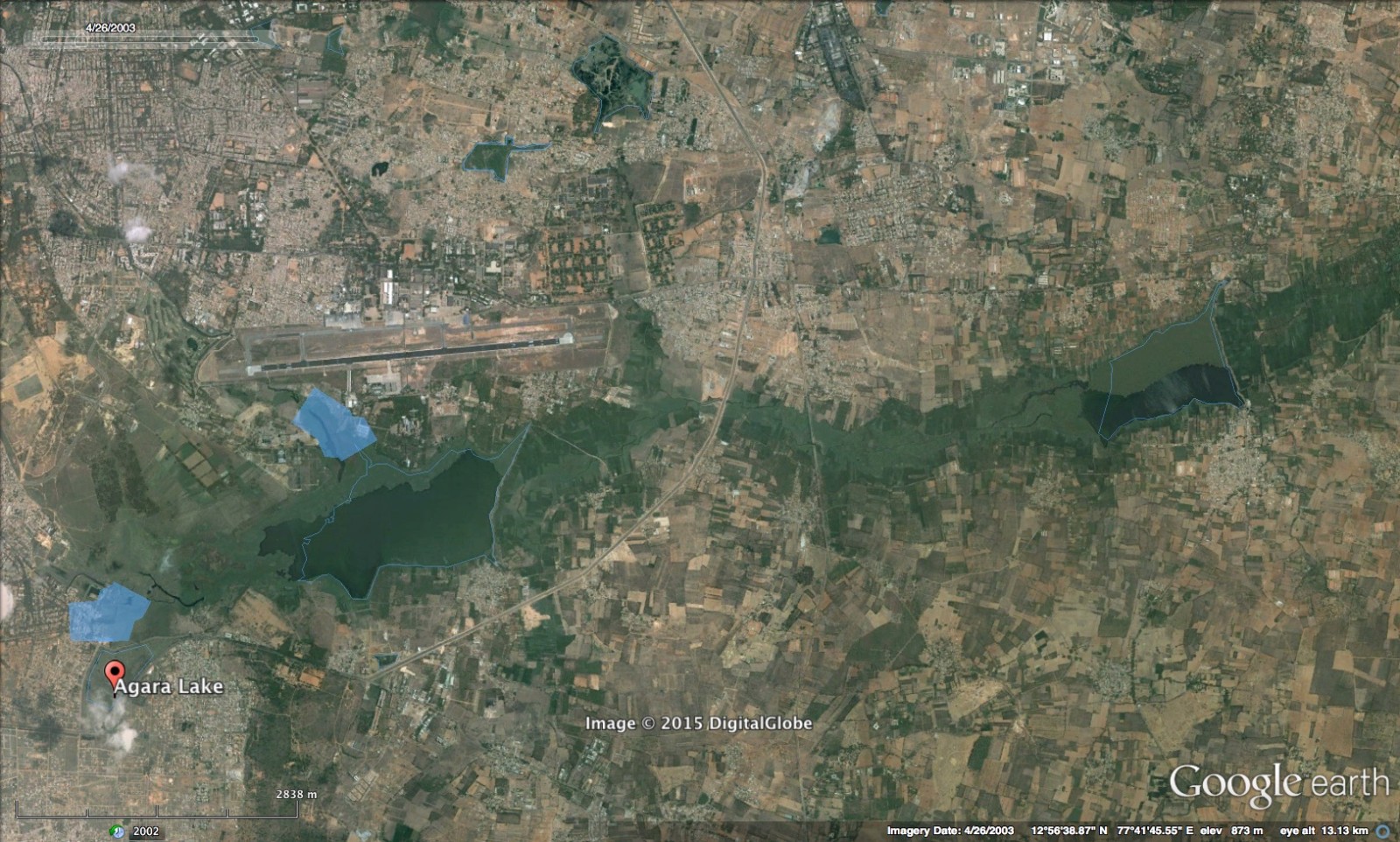
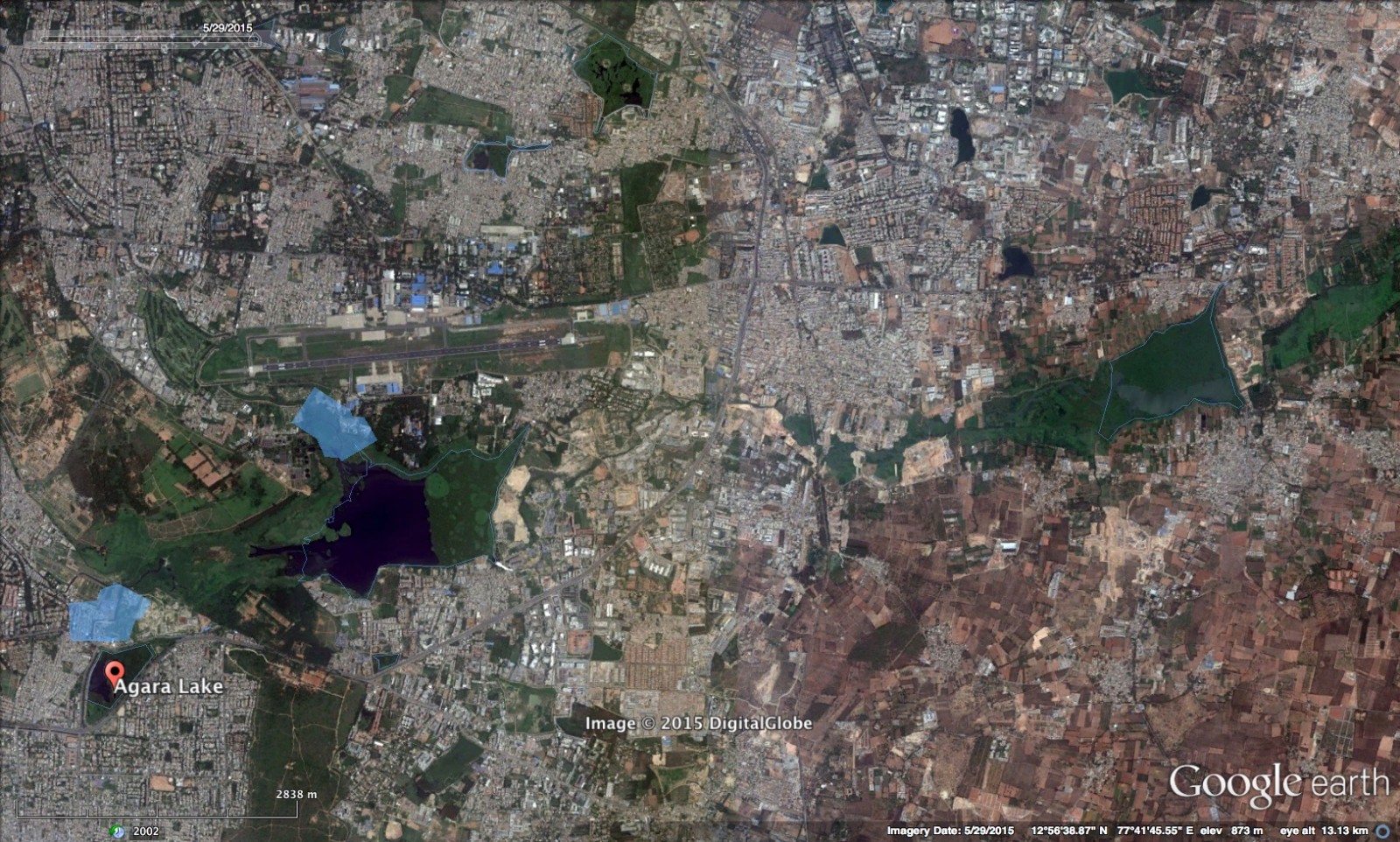
Unmindful, the city grows apace. The detritus of construction clogs every locality, every street. Each fresh concrete tower poking up from the hard, dry land guzzles water in its making; once complete, it is inhabited by hundreds of people who need even more water. Growth escalates further, as plans for seven satellite towns and IT corridors move from the blueprint table to the increasingly arid rockscapes of suburban Bengaluru.
Even as borewells suck the ground dry and collude with massive pipes to drain the Cauvery, the city’s once-reliable water source – the wells and tanks that Kempe Gauda and his successors planned with such foresight – become choked with the effluents of industry while its rivers, impregnated with the toxic sludge of urban life, run black all year round.
Bengaluru, one of the fastest growing cities in the world, is in danger of turning into a choked, polluted dustbowl.
Unless something changes.
(Note: For an India obsessed with urbanisation and seduced by the idea of smart cities proliferating across the land, Bengaluru is both case study and cautionary tale. It is the many ramifications this story – of unbridled development that outpaces a population’s most essential resource – that I will now begin to explore, feet-on-ground, over the coming weeks.)
* The Cauvery Tribunal has allocated 37% to Karnataka and 58% to Tamil Nadu. Of the 37% Karnataka has, majority is for irrigation. The additional demand for Bengaluru will have to take away from the irrigation allocation.
SOURCES/ REFERENCES:
- Mysore, A Gazetteer Compiled For the Government; B. Lews Rice, 1897
- *Bangalore City’s Water Supply, A Study & Analysis in Essays on Bangalore, Vol.4; D.K. Subramanian, 1985
- A Journey From Madras Through The Countries of Mysore, Canara, and Malabar; Francis Buchanan, 1807
- Bangalore Through The Centuries; M. Fazlul Hasan, 1970
- Tank Irrigation In Karnataka, A Historical Survey; G.S. Dikshit, et.al., 1993
- Central Groundwater Board website: http://www.cgwb.gov.in/
- Travels of Jesuits Into Various Parts Of The World, Lockmann
- Memoirs Of My Working Life; Sir M. Visvesvaraya
- Various lengthy conversations with S. Vishwanath, Leo Saldanha, Bhargavi Rao, Veena Subramanian, Sharadchandra Lele, and others.


Thanks for highlighting this impending crisis. Have become a fan of your writing. Can’t wait for the next one.
Your article is well researched. It serves to confirm what many experts in the field have been warning the government about for decades.
I was at Hesaraghatta last Sunday, to photograph migrant birds. I was appalled at the state of the place. Once a haven for rare migrant birds and other fauna, Hesaraghatta is now an open-air bar & restaurant – and a well known venue for rave parties.
The approach road to Hesaraghatta was, until a few years ago, completely covered by a canopy of Ficus and Delonix trees. It is now a concrete jungle, and more crowded than Hosur road, even on a Sunday.
Bangalore’s demise is inevitable. Your article makes one realise that the city’s demise is not just inevitable, it is imminent.
Not many people will appreciate the import of your article, I’m afraid. And no one will act on it.
You’re a fine writer and a good researcher.
SK Srinivas
Thank you, sir, for taking the time to write in with thoughtful comments. Hoping that the demise is NOT inevitable 😉 there are ways to reimagine and revive this city. Hope lives!
Both the articles are very interesting and beautifully written. It would be interesting to evaluate how the system worked as a loop. What happened to all the water used up by this huge population. The sewage system and its recyclability.
Exactly the plan, Lalitha. These are the first two articles in a long series. We will be looking at the whole cycle, throughout the basin, including across the border. Thanks so much for your kind words and for writing in.
best,
Arati
Great article. The ecology and wetlands division at IISc are also doing great work at analyzing the groundwater availability and changes along the years. You should get in touch. I feel you already have done that!
I still cannot understand what happens to the rain water which floods the streets every other day. Why doesnt that rain water replenish the ground water tables?
Pleasure to read on a mobile phone screen, your pictures rendered very well. Enjoyed the story-telling and reporting. Can imagine a lot of hard-work went into it. Could you tell me how much time it took?
This is a brilliant series, thanks for taking such an effort. Please try to cover mitigation strategies. How water treatment, lake rejuvenation could help, and how could we as a community could come together and bring about the change.
A very well researched, thought provoking and at the same time frightening article! Kudos to you Aarti! It will take more than just the will of the government to fix problems that we are also directly or in-directly the cause of. I wish everyone gets to read this and more than that look at ways and means of how we can all do a little extra to conserve water. I have forwarded the link to all my friends and hopefully, they will in their own little way become or at least try to become change agents! All the best!
Eye Opening…Arati very well researched and written! You have beautifully woven history with facets of what we see today. I shudder to think of the pollutants in the water we are all consuming today!
Proud of the work you have been doing…
A great article, very well researched and written series. Very much needed as a eye opener for many of us in the society, so that we can collectively act, before it is too late.
I think, you should look at getting this series translated to Kannada/Hindi and distribution thru NGO/volunteer channels, for wider awareness. (If not the whole series, the highlights of the history, steps taken at different times to provide water to the city and the impact of current development would help, IMHO)
Thanks again, for taking up such an important topic and writing it beautifully
The analysis that undergirds the story is excellent. It was an eye opening learning experience for me. Thank you.
It is my experience that restraining organic growth and development of cities is a near impossible endeavour. The best one can do is manage cities.
Given the gravity of the challenge, conservation and recycling are likely to be practical.
It is always easy to recommend solutions. The real challenge for Bengaluru is good governance. People like you and others who share your views are the only hope.
Politics is a noble calling but is a dirty business because good people refuse to participate in a liberal democratic society like India. It is my hope that people like you can mobilize responsible citizenship. It is not enough to mobilize but people like you need to consider public service as a life-long calling.
My lame excuse for not entering politics is that I am still an adolescent at 75. Enough said. All of you dedicated people who want to enter politics have a sincere person rooting for you.
Your two stories are both enlightening and enjoyable. You deserve high praise.
Very nicely written again. I think if you can also highlight some possible solutions that the government and NGOs are working on, the article wouldn’t paint as sad a picture.
Brilliant article.
Research ***** (five stars)
Writing *****
Substance overall *****
Reach *
I ponder on the magnitude of impact that would get generated if the top news publishers wrote like you did/do. Just amazing. Keep it going
This is looking like a Doomsday waiting to happen. Bengaluru – wake up!!
Wonderful, Arathi! Keep going. Wish to read more and more. Thanks to Tejaswi, for passing the link to me.
– Shyamala Madhav.
Chanced upon this yesterday.
Excellent, Well written piece….
Arati : What do you think is the solution ? Do you have an article in mind to address possible solutions ??
If we calculate the rain received by Bengaluru they can still survive if they tap rainwater properly. There will be surplus to give to others.
Very informative thought provoking. Thanks a lot. Keep it up.
This is beautiful reporting .. facts with story telling.
is this page taken down ? I do not see the article but only the comments
Truly an eye-opener. I am shocked at my own ignorance of not knowing about this most important issue in all the years of my association and living in Bengaluru. Thanks so much for very meticulously sharing the details.